Ink, Bits and Tokens
A History of Information and the Collapse of Its Old Paradigm.
10 min read

In the mid 15th century, Johannes Gutenberg’s printing press fundamentally changed human civilization. The change was not just a technological change but it represented a “paradigm shift” in how information could exist and flow through society. Before the printing press, knowledge moved slowly and unevenly. Books were copied by hand, owned by elites, and had a problem of human error. Information was scarce, fragile, and tightly controlled. After the press, information became accurately reproducible and democratized. This transformation reshaped politics, science and culture, stripping the Church of its monopoly on information and eventually giving rise to the scientific revolution. Three centuries later, the French Revolution would be shaped by rapid spread of ideas with the help of newspapers and cheap books, made possible by the printing press, showing us how shifts in information transmission can fundamentally alter the course of social change. Philosopher Thomas Kuhn used the term “paradigm shifts” to describe such changes, points where the old way of understanding the world breaks, and a completely new framework takes its place. We are witnessing another such shift today and to understand what makes this moment so significant we need to look at how information has evolved through history, in different forms and technologies.

Gutenberg and The Printing Press
For thousands of years information existed only in human memory and speech, Vedas and sacred texts for example were preserved with the help of oral tradition, passed from teacher to student, chanted and memorized across generations. Writing changed this by allowing information to exist outside the human mind, inscribed on palm leaves, papyrus, and parchment, though each copy still required high human effort. The printing press as discussed earlier made information reproducible at a scale, allowing identical copies to be spread across continents, but remained static in the ink of paper. Computers and the internet introduced a completely new dimension where information became digital, making it transmissible at the speed of light, yet it required human effort and programming to create or modify. Now with Artificial Intelligence we are noticing something fundamentally different, information is generated on-demand based on learned patterns, rather than simply fetched from storage. Traditional computers follow fixed rules and stored answers. AI systems probabilistically construct outputs by recognizing patterns across vast amounts of training data, producing responses that didn’t exist as discrete entities before the moment of request.
For decades the digital systems have been built around bits and bytes, binary digits for storage and transmission. A byte is eight bits, everything from a paragraph to a photograph exists in sequences of these units. AI systems, however, operate one step closer to how humans use language. While they still run on bits and bytes underneath, they handle texts in larger chunks called “tokens”, which are just chunks of text like “the” or “ing”. These tokens serve as the building blocks of probabilistic predictions. Tokens aren’t a new unit of information in the same sense as bits and bytes, they just represent an optimization for a fundamentally different task. Where bits and bytes optimize for storage and transmission, tokens optimize for generation. This distinction is very important as it reflects a shift in what we are trying to do with the information. It is now reshaping the digital economy, as companies become “token factories” whose primary output is AI generated content measured in tokens rather than traditional digital files. The value of these “token factories” is now tied to their token generation capacity. But what makes this token-based generation possible? The move from search to generation happened because of three main pillars: algorithms, data and compute. Each one depends on the other, better algorithms need more data and compute. Compute is useless without models and data fed into those models. If any one of them is weak, progress stalls. Together, they decide not only what AI can do, but who gets to build and control it.

A Representation of Tokens
Algorithms are mathematical architectures that define how an AI system will learn and generate output. AI learns through neural networks, systems inspired by how the human brain connects neurons. Neural networks shift the paradigm from explicit programming to pattern recognition. The real breakthrough happened in 2017 with transformer models, which gave AI the ability to focus. Rather than processing all information the same way, it learns what matters most in a sentence and what can be paid less attention to. This architectural innovation transformed language modeling from a research problem into practical technology. The algorithms are often published openly in academic papers and shared as open-source. The recipe is known, the challenge lies in executing it at scale.
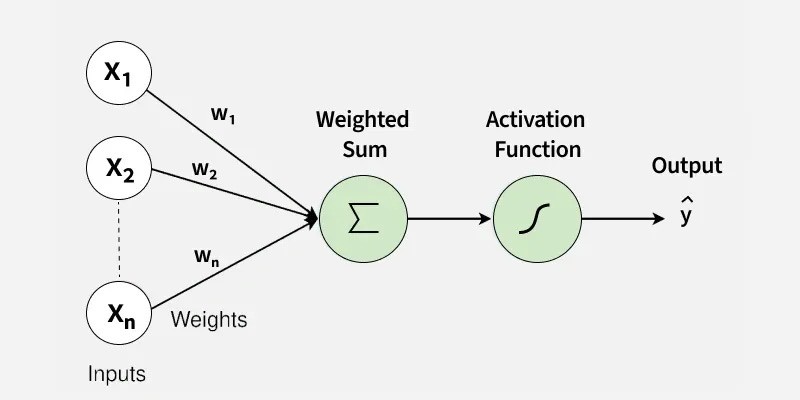
Perceptron: The Simplest Neural Network
Data is what trains these algorithms. AI models learn statistical patterns by processing huge quantities of examples. A language model is trained on trillions of tokens from books, websites, and forums, adjusting its parameters to predict what comes next in the sequence of words it is generating. The quality, variety, and scale of training data directly determine a model’s capabilities. Models trained on English language struggle with other languages, models trained on 2010s data lack recent knowledge. This implies that the best models require data at a scale few organizations can access. Companies like Google, xAI and Meta have massive datasets from years of user interactions, while others rely on public internet data. Who controls access to high-quality data increasingly determines who can build competitive AI, making data access a geopolitical and economic chokepoint.
Compute is the processing power required to train and run these models. Training a state-of-the-art system involves trillions of mathematical operations across many thousands of GPUs, running for weeks and costing tens of millions of dollars. Compute is no longer just a question of capacity, but of speed. In this fast-moving world, delays cost relevance. One example of this is when Elon Musk’s xAI constructed their Colossus data center in 122 days, a process that typically takes years. Companies and countries without the ability to rapidly scale compute risk becoming irrelevant because they simply cannot keep pace with the rate of continuous development.

Different models, same dependency

Colossus | xAI
The strategic importance of compute became clearly visible when in 2022 the United States imposed export restrictions on Advanced AI chips to China, aiming to maintain technological hierarchy by restricting access to the best of the world hardware. This pattern can be traced back to the 1990s when the western nations refused to sell cryogenic engines to India for its indigenous space program. India was forced to develop its own capabilities acting as a constraint that ultimately led to indigenous innovation and self-reliance. Cut off from NVIDIA’s most powerful A100 and H100 GPUs, Chinese AI companies had to find another path forward. Use open-source algorithms, publicly available research papers, and act with cleverness in optimization. Unable to access the latest chips, DeepSeek, a Chinese AI company, built competitive models by leveraging open-source foundations and architectural papers freely shared on platforms like arXiv. The algorithmic knowledge, the “recipe” for building AI, was never restricted. Only the compute power was. DeepSeek responded by making better use of the hardware it already had through software improvements. This reduced the amount of computing power required to train them. As a result, their models, even though trained on older and weaker chips, were able to perform at a level comparable to Western models built using unrestricted access to advanced hardware.

A Public Archive for Open Research Papers
The Deepseek example reveals a ground truth about technology, innovation does not always emerge from foundational research or superior resources. Often, it comes from constraint-driven adaptation, taking what is available and applying it with creativity. China’s AI progress is not rooted in inventing neural networks or pioneering transformer architecture (though improving it later with techniques like Multi Head Latent Attention), those breakthroughs came from researchers in the West. Instead, Chinese companies have excelled at applied innovation, refining existing techniques, focussing on efficiency, and distributing improvements rapidly across their AI ecosystem. The open-source nature of AI research, where papers are published openly and code is shared freely, means that the knowledge itself cannot be bottlenecked.
The speed at which AI is transforming the creation of value is something that was never seen before. Consider Lovable, an AI apps development platform (anyone without any knowledge of coding can build full stack apps with Lovable) that reached $100 million ARR in just 8 months, making it the fastest company in history to achieve this milestone. To understand how remarkable this is, compare this with other technology companies that were already considered astonishingly fast in achieving this milestone. Cursor, again an AI coding platform for developers, took one year to complete the same milestone. OpenAI, despite creating ChatGPT and fundamentally reshaping public awareness of AI, needed over two years to cross $100 million in revenue. Companies like Twilio and Shopify required five to six years to reach the same revenue mark. This compression of time isn’t just about better marketing or network effects, it shows a fundamental shift in how value is created and delivered when AI is embedded into products from day one.

How AI compresses the time taken to create value
The difference between Lovable’s six-month trajectory and OpenAI’s two-year path reveals a foundational distinction in how AI products are built and scaled, a distinction between bounded and unbounded tasks. Bounded tasks are those where the scope of work is clearly defined, you know what problem you’re solving, what the inputs and outputs should be, and when you’re done. Lovable is a bounded product which builds websites. When a user describes what they want, Lovable knows its job is to generate code to that specific website. The boundaries are clear. Cursor, similarly, is bound to code editing, it assists developers within the context of their existing code, understanding that its role is to autocomplete, refactor, or debug. These products don’t try to do everything, they just do one thing exceptionally well within a constrained domain.
Unbounded tasks, by contrast, have no clear limits. Products like ChatGPT, Gemini, and Claude are general-purpose AI assistants that can be asked anything, from writing poetry to debugging code to explaining quantum computing to planning a vacation to Ladakh. There’s no predefined scope, no clear endpoint, and no single measure of success. They must handle infinite possible queries across infinite domains, which makes them extraordinarily powerful but also extraordinarily complex to build and scale. The infrastructure required to support unbounded AI is massive. These systems must be trained on enormous datasets covering every thinkable topic, and must be deployed with enough computational capacity to serve millions of unpredictable queries simultaneously. The cost is huge, training runs in the tens of millions of dollars, running them at scale costs hundreds of millions more, and ongoing improvements require continuous reinvestment, as speed matters. Bounded AIs, instead, can scale faster precisely because they avoid these unreasonable infrastructure costs. They can take existing open-source models, fine-tune them on high-quality domain specific data, and deploy at a fraction of the cost, allowing smaller teams to compete effectively while reaching the scale faster.

Large Language Models (Unbounded Tasks)
For India, this moment presents both an opportunity and a responsibility. There are two ways to build power in technology, scale horizontally by reaching everywhere fast, or integrate vertically by controlling the full stack over time. India faces pressure to pursue both strategies in parallel. Horizontally, leverage lies in today’s cheap AI costs and open-source abundance to build bounded applications that solve immediate problems and generate economic value. This creates jobs, builds expertise, and establishes India as a hub for “applied” AI innovation. Vertically, the focus shifts to investing in the deeper layers of the stack, compute infrastructure, chip design, algorithmic research, and model training capabilities. This means learning from China, optimizing algorithms to make constrained hardware more efficient, investing in domestic GPU development, and building data centers at scale. It also means funding research institutions, training AI talent, and creating incentives for long-term infrastructure projects that may not yield immediate returns but will determine India’s strategic autonomy in a decade. The two approaches serve different time horizons. Horizontal scaling generates the revenue and expertise to fund vertical integration. Vertical integration ensures that India doesn’t remain perpetually dependent on foreign infrastructure and has its own AI to represent its diversity.

India’s dual strategy for building AI capability
Across history, changes in how information is created and shared have reshaped society itself. Ink preserved information, bits moved it, and tokens allow it to answer back. Information is no longer just stored or retrieved, it is produced on demand. This transition represents the precise moment Thomas Kuhn described, where the old framework of understanding the world breaks, and a new one takes its place. In this new paradigm, we are no longer simply organizing information created in the past. We today live in a world where information generates answers in real time. The shift is complete! Information is no longer a mirror reflecting what exists. It has become a force that shapes what comes next.
Join the newsletter
Be the first to read our articles.